From Table to Screen: How Craps Statistics Inform Slot Game Selections Within Bonus Wagering Frameworks
Written by Katja Brooks · Aug 2, 2026

From Table to Screen: How Craps Statistics Inform Slot Game Selections Within Bonus Wagering Frameworks
Players encounter distinct mathematical structures when moving between craps and slots, and these structures interact directly with wagering requirements that dictate how bonus funds convert into withdrawable cash. Craps features transparent probabilities such as the 1.41 percent house edge on pass line bets with full odds, while slots operate through random number generators calibrated to specific return-to-player percentages that range from 94 to 98 percent in regulated markets. Observers note that the variance profiles differ sharply, yet both games sit under the same playthrough multipliers that can reach 30 times or higher on deposit bonuses.
Craps Probability Foundations
Standard craps layouts present multiple betting options whose expected values researchers have calculated across millions of rolls, and data from the Nevada Gaming Control Board shows consistent long-term outcomes for pass and come bets when players take maximum odds. The don't pass bet carries a lower house edge of 1.36 percent before odds, which shifts decision-making for those who track volatility across sessions. These fixed percentages stand in contrast to slot mechanics where each spin resolves independently according to weighted reel strips rather than sequential dice outcomes.
Slot Mechanics Under Wagering Terms
Slot titles display advertised RTP figures that regulatory bodies require operators to verify through independent testing, and industry reports indicate that medium-volatility games often balance hit frequency with payout size in ways that align with extended playthrough cycles. Wagering requirements multiply the bonus amount by a set factor before players access winnings, so selections that maintain steady bankroll movement become relevant when the multiplier stretches across hundreds of spins. Figures from the Australian Communications and Media Authority reveal that slots with RTP above 96 percent retain more player funds over 1,000 spins compared with lower-return titles under identical conditions.
Connecting the Two Game Types
Although the random processes differ, probability awareness from craps carries over when players evaluate slot volatility against the remaining wagering obligation. A pass line strategy that minimizes edge in craps encourages parallel attention to slot paytables and bonus features that contribute fully toward requirements. Data shows that games with frequent small wins help sustain the balance needed to complete high multipliers without rapid depletion, whereas high-volatility slots may exhaust funds before the playthrough finishes even if their theoretical RTP matches a craps edge over time.
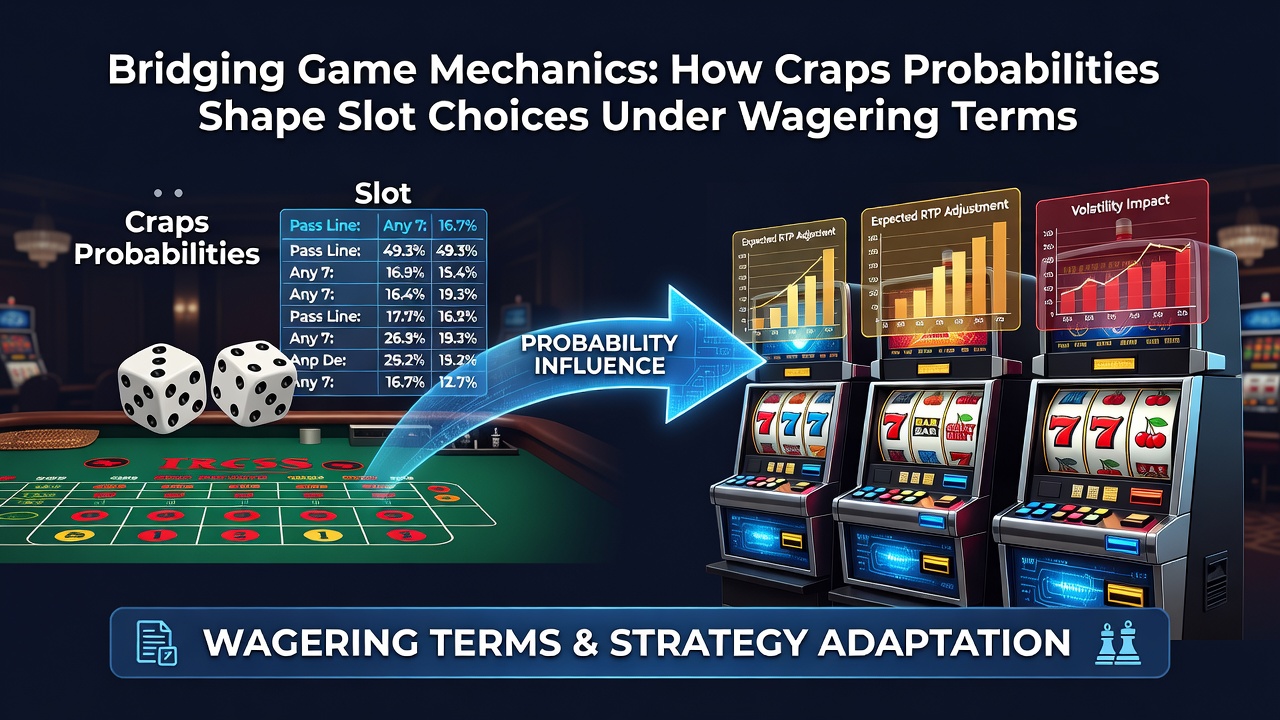
One study from the University of Nevada examined player behavior across both table games and video slots and found that participants familiar with dice probabilities gravitated toward slots whose hit rates mirrored the steady progression of odds bets. This pattern appears because the transparent math of craps trains attention toward expected value per decision, which translates to scrutiny of slot feature contribution rates listed in game rules. When a wagering term requires 40 times the bonus, titles that allocate at least 90 percent of wagers to qualifying spins reduce the effective cost of completion.
Practical Selection Patterns
Regulatory data collected through 2025 demonstrates that operators in multiple jurisdictions publish game contribution percentages, and these percentages determine how much each spin counts toward the total. Players who apply craps-derived edge calculations often prioritize slots where wild symbols and free-spin triggers appear at intervals that sustain momentum rather than clustering in rare large payouts. The reality is that variance spikes can force earlier exits from bonus rounds when the remaining playthrough exceeds available credits, a dynamic less common in low-edge craps sessions supported by odds bets.
Regulatory Context and Data Trends
European regulators including those in Malta have required clearer disclosure of RTP ranges and bonus contribution weights since updates implemented in prior years, and similar transparency measures appear in Canadian provincial frameworks. These disclosures allow direct comparison between craps table edges published by gaming commissions and the effective cost of slot play under multipliers. Reports indicate that average completion rates for wagering requirements hover near 65 percent when players select medium-volatility titles, while high-volatility selections show wider dispersion in outcomes.
Conclusion
Mathematical structures from craps provide a reference framework for evaluating slot selections when wagering terms govern bonus conversion. Fixed probabilities on the dice table highlight the value of minimizing house edge per decision, and that principle extends to reviewing RTP, volatility, and contribution rates before committing spins. Industry data and regulatory filings continue to supply the objective metrics that support these cross-game comparisons without requiring subjective preference.