Community Insights into Bankroll Management for Varied Game Sessions at Casinos
Written by Alex Keller · Aug 16, 2026

Community Insights into Bankroll Management for Varied Game Sessions at Casinos
Player communities have long shared methods for dividing bankrolls during sessions that span several casino games, and these discussions often focus on practical allocation techniques that adapt to different game types and session lengths. Observers note that participants in forums and chat groups frequently describe dividing funds into segments based on game volatility, expected duration, and personal risk thresholds, while data from regulatory reports continues to track overall player spending patterns across regions.
One common approach discussed involves setting aside specific percentages for each game category before a session begins, and this method appears in threads where users outline how they reserve 40 percent of a total bankroll for slots, 30 percent for table games, and the remaining 30 percent for video poker or other options. Researchers at the Australian Gambling Research Centre have documented similar proportional strategies in player surveys, noting that such divisions help maintain session structure when switching between games with distinct house edges and payout frequencies.
Percentage-Based Allocation Techniques
Forum participants often explain percentage-based allocation by breaking a bankroll into fixed ratios that reflect game characteristics, and they emphasize adjusting those ratios if a session extends beyond the planned timeframe. Data indicates that players who apply this method typically review historical session logs to refine the percentages, since outcomes from high-volatility games can shift remaining funds quickly and require reallocation mid-session. Studies from the University of Nevada Las Vegas gaming research program show that participants using percentage splits report more consistent tracking of expenditures across multi-game formats compared with those who allocate without predefined ratios.
Community members also describe layering these percentages with session time limits, and they combine the two by assigning a dollar amount per hour to each game type before play starts. This creates a hybrid model where the initial percentage split serves as the foundation while hourly caps prevent overextension when moving from one game to another. Figures from the Nevada Gaming Control Board reveal steady increases in reported multi-game participation through mid-2026, with August 2026 data highlighting that players who predefine both percentages and time limits tend to stay within overall spending boundaries more often.
Fixed Amount and Tiered Reserve Methods
Another set of strategies centers on fixed dollar amounts assigned to each game in advance, and players in these discussions stress the importance of separating the amounts into distinct digital wallets or physical envelopes when possible. Those who've tried this approach frequently mention starting with smaller fixed sums for games they consider secondary, then scaling up the primary game allocation if early results allow. Industry reports from the Canadian Gaming Association indicate that fixed-amount methods appear most often among players who participate in sessions lasting two to four hours and involve three or more distinct game categories.
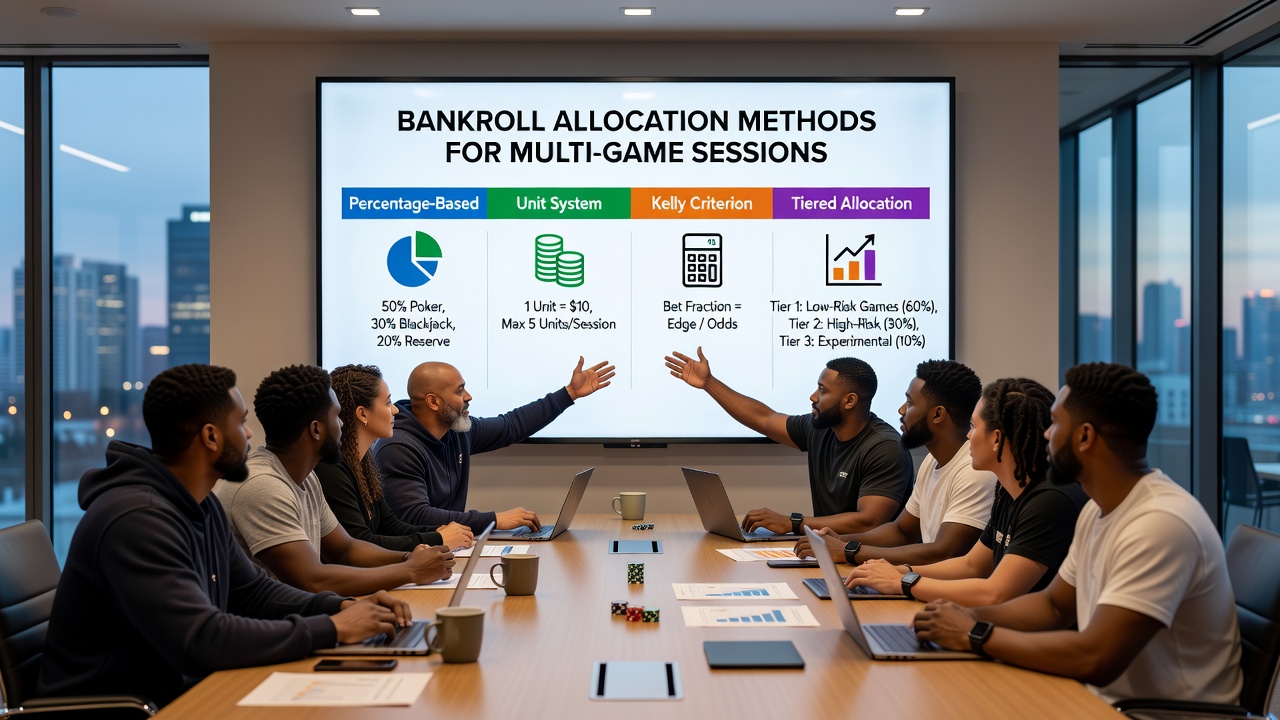
Tiered reserve systems build on fixed amounts by creating backup layers that activate only after the first tier is depleted, and community threads show users outlining primary, secondary, and emergency reserves for each game. The primary reserve covers the initial planned play, the secondary reserve activates if a game shows favorable short-term results, and the emergency reserve remains untouched unless all other funds are exhausted. Academic papers published through the International Gambling Studies journal document that players employing tiered reserves maintain longer average session durations without exceeding self-imposed limits, particularly when switching between slots and table games.
Adjusting Allocations Based on Game Sequence
Discussions also cover dynamic adjustments made during a session, and participants describe monitoring win or loss thresholds that trigger a shift in remaining bankroll distribution. For example, a player might begin with equal allocations across four games but move unused funds from a low-volatility option into a higher-volatility one after reaching a predetermined win target. Reports compiled by the Malta Gaming Authority note that such in-session reallocations occur regularly among experienced multi-game participants, especially during extended evening sessions that run into August 2026 and beyond.
Community members frequently reference software tools and spreadsheets that track these adjustments in real time, and they share templates that calculate remaining percentages automatically after each game segment concludes. These tools integrate with casino apps that log play history, allowing users to review allocation accuracy after the fact and refine future plans accordingly. Evidence from multiple regulatory summaries shows that players who document reallocations maintain clearer records of spending across game types than those who track only total session results.
Conclusion
Player communities continue to exchange detailed bankroll allocation methods for multi-game sessions, and the techniques they describe range from simple percentage splits to tiered reserves with mid-session adjustments. Reports from organizations such as the Australian Gambling Research Centre and the Nevada Gaming Control Board provide supporting data on how these approaches align with broader spending patterns observed through 2026. Those who study these discussions find consistent themes around pre-session planning, game-specific reserves, and ongoing monitoring that help structure play across different casino formats.